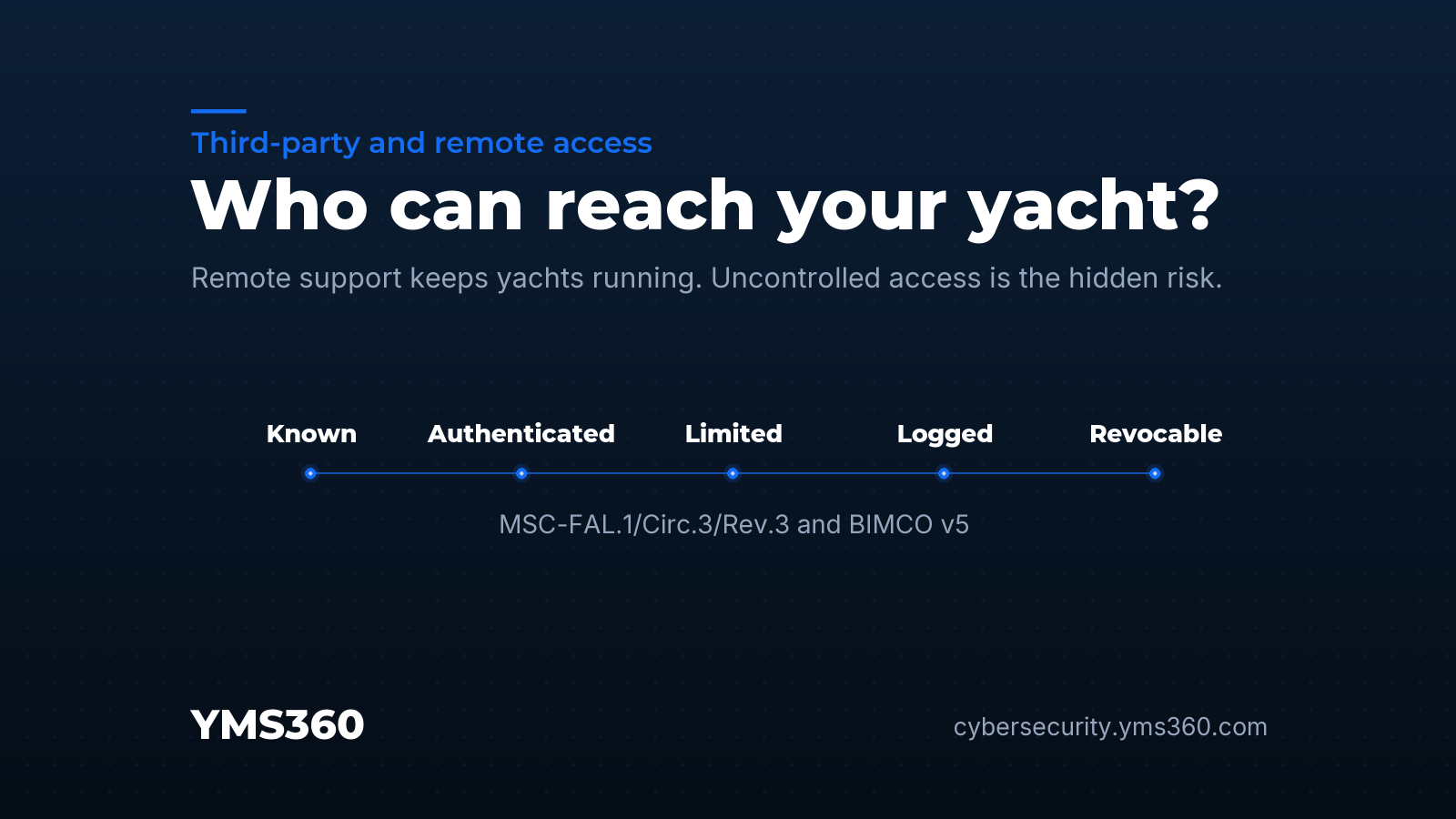
Remote support keeps yachts running, but uncontrolled vendor access is one of the least visible cyber risks aboard. How to make access known, authenticated, limited, logged and revocable.
A modern superyacht can be thousands of miles from the engineer who knows how to fix the problem. That makes remote access incredibly valuable.
AV integrators, IT providers, satellite and connectivity companies, equipment manufacturers, management companies and specialist technicians may all need to support systems aboard a yacht without physically being there. In many cases, that capability keeps the vessel operational. It can also create one of the least visible cybersecurity risks aboard.
The problem isn't remote access itself. The problem is remote access without enough control around who can connect, what they can reach, how they authenticate and whether anyone can reconstruct what happened afterward. And on a yacht, those questions can become complicated very quickly.
A yacht may have more remote access than anyone realizes
Ask someone aboard a yacht how many organizations can remotely access vessel systems and you may get a confident answer. Ask them to produce a complete list, and the answer can become less certain. That is understandable.
Modern vessels may rely on remote support for:
- network infrastructure;
- firewalls and Wi-Fi;
- AV systems;
- satellite and cellular connectivity;
- CCTV;
- access control;
- onboard servers;
- bridge or navigation equipment;
- monitoring platforms;
- lighting and automation;
- software platforms; and
- equipment maintained directly by manufacturers.
Some access may be permanent. Some may be enabled only when support is required. Some may have been installed during the build or a refit. Some may have been established by a technician years ago and simply continued working.
That creates an important cybersecurity question: does the yacht know every pathway by which somebody outside the vessel can reach a system inside it? If the answer is uncertain, that uncertainty itself is a risk.
The IMO specifically recognizes third-party connectivity
This isn't merely an IT-provider concern. The IMO's current Guidelines on Maritime Cyber Risk Management explicitly address systems interacting with third-party and landside networks, and recommend protecting Internet-connected systems with measures such as firewalls, controlled access, logging and network segmentation. The guidance also recommends identifying external dependencies and network connections as part of understanding a vessel's cyber risk.
That matters because remote support changes the security boundary of a yacht. Traditionally, we might imagine that boundary as the firewall sitting between the yacht and the Internet. In practice, the boundary extends outward to every organization that is trusted to cross it.
A third-party technician's laptop can matter. The MSP's identity controls can matter. The vendor's password policy can matter. The security of the remote-access platform itself can matter. Cybersecurity becomes a trust-chain problem.
Convenience has a way of becoming permanent
Remote access often starts for a perfectly legitimate reason. Something stops working. A technician needs access. A VPN account gets created. A remote desktop service is enabled. A firewall rule is changed. The problem gets fixed. Everyone moves on.
The problem is what happens afterward. Was the account disabled? Was the firewall rule removed? Was the password unique? Was access limited to the system the technician actually needed? Was the session logged? Does anybody know whether the credential still exists six months later?
This is where operational convenience can gradually become accumulated cyber risk. Not because somebody did something reckless, but because systems evolve. People leave. Vendors change. Refits add equipment. Support arrangements change. And remote-access paths can survive all of them.
Shared credentials are particularly dangerous
One of the easiest operational shortcuts is also one of the weakest security models: the shared vendor account. Perhaps the username is something like vendor_support. Several technicians know the password. It rarely changes. Nobody is quite sure who used it last.
From a support perspective, it is convenient. From a cybersecurity perspective, it creates several problems. You lose individual accountability. If one technician leaves the vendor, you may need to change credentials for everyone. If the password is exposed, there may be no easy way to determine who actually used it. And if the same credential is reused across multiple vessels, a compromise can potentially become much larger than a single-yacht problem.
The IMO's current cyber guidance recommends assigning unique credentials to users, separating normal and privileged accounts, removing access for departing users and using multi-factor authentication where appropriate. Those are not exotic cybersecurity controls. They are basic identity hygiene. But on highly serviced environments such as yachts, implementing them consistently across vendors can be surprisingly difficult.
MFA matters, but it doesn't solve everything
Multi-factor authentication is one of the most effective controls available for reducing the risk associated with stolen passwords. It should be used wherever practical for remote access. But MFA should not become the point at which the conversation ends.
Consider two scenarios. In the first, a technician authenticates with MFA and then receives unrestricted access to a large portion of the vessel network. In the second, a technician authenticates with MFA, can access only the equipment they are responsible for, only while a support session is authorized, and the activity is logged. Both technically use MFA. They are not equally secure.
Good remote-access design involves layers:
- Who are you? Authentication.
- What are you allowed to reach? Authorization.
- When are you allowed to connect? Access control.
- What did you do? Logging and accountability.
- What happens when you no longer need access? Lifecycle management.
That is a much stronger model than simply adding MFA to an old remote-access architecture.
Segmentation changes the consequences of a compromised account
Network segmentation is another reason remote-access architecture matters. Suppose a third-party AV technician requires remote access to an AV control processor. Do they need access to the crew network? The owner network? The bridge network? The CCTV environment? The firewall? The vessel's servers? Probably not.
A compromised credential becomes significantly more dangerous when it opens doors into unrelated systems. The IMO's current cyber guidance specifically recommends segmentation between OT and IT environments as part of its minimum controls.
For yachts, the broader principle is equally useful: access should be limited to what the user actually needs. A yacht does not need one giant trusted network simply because all of the equipment happens to be onboard the same vessel.
The vendor laptop matters too
Remote access is only one form of third-party access. Sometimes the third party is physically onboard. BIMCO's Guidelines on Cyber Security Onboard Ships highlights the risk created when technicians, vendors or other visitors connect laptops, tablets or removable media to vessel systems. It specifically notes that ship visits can create a connection between onboard systems and shore-based environments, and that third-party devices may introduce malware or other risks.
This is extremely relevant to superyachts. During a refit or service period, a yacht can have a remarkable number of external people interacting with its technology: AV technician, network engineer, lighting programmer, security contractor, satellite technician, automation specialist, manufacturer representative.
Each person may be perfectly legitimate. But every connection increases the number of trust decisions being made. This is one reason cybersecurity cannot simply be reduced to "protect the yacht from hackers on the Internet." Trusted people and trusted vendors still need controlled access.
MSPs have a particular responsibility
Managed service providers occupy an unusual position in yacht cybersecurity. An MSP may have administrative access to many vessels simultaneously. That creates tremendous operational value. It also creates concentration risk.
If an MSP's remote-access environment or privileged credentials were compromised, the attacker might not gain access to one yacht. They could potentially gain a pathway toward several. That changes the cybersecurity obligation of the service provider.
A yacht should reasonably want to understand things such as:
- Are technician accounts individual or shared?
- Is MFA required?
- How are privileged accounts managed?
- What happens when an employee leaves?
- Are remote sessions logged?
- Are client environments separated from one another?
- Can technicians reach an entire vessel network, or only the systems they support?
- How are emergency access and temporary access handled?
- Are the devices used by technicians themselves managed and protected?
These aren't questions designed to make support difficult. They are questions designed to preserve the trust on which remote support depends.
Remote access should have a beginning and an end
One of the simplest principles in cybersecurity is also one of the most useful: access should exist for a reason.
If a vendor requires permanent monitoring access, document why. If a technician requires temporary support access, make it temporary. If an employee leaves a provider, remove the account. If equipment is replaced, remove the old access path. If a relationship with a vendor ends, revoke the credentials.
The IMO's guidance specifically calls for collecting security devices and deactivating accounts belonging to departing employees or users. The same philosophy should apply to yacht vendors and contractors. Access shouldn't quietly become permanent simply because nobody remembered to remove it.
Logging answers a very important question
When something unusual happens aboard a yacht, one of the first questions may be: what changed? That can quickly lead to others. Who logged in? From where? At what time? What system did they touch? What configuration changed? Was somebody performing legitimate maintenance?
Without logs, those questions become archaeology. The IMO's current guidance specifically recommends collecting and securely storing logs for intrusion detection and incident response.
That is important for remote access because accountability should not depend on memory or chat history. A well-managed environment should be capable of reconstructing important administrative activity, not because every technician is suspect, but because when troubleshooting a complex incident, evidence matters.
This is why training technical personnel is different
Crew cybersecurity awareness remains important. But remote-access risk illustrates why technical personnel need deeper cybersecurity knowledge. Someone administering a vessel network should understand more than phishing. They need to understand concepts such as:
- segmentation;
- privileged access;
- secure remote access;
- identity management;
- firewall policy;
- logging;
- endpoint protection;
- third-party trust;
- OT exposure; and
- incident response.
Those topics are deliberately part of the Cyber Ready — Professional curriculum, including Network Architecture & Segmentation, Secure Remote Access, Identity & Access Control, Endpoint, OT & Bridge/IoT Hardening, and Monitoring, Incident Response & Continuity. Because technical cybersecurity aboard a yacht is not abstract. It is the architecture people interact with every day.
A useful remote-access test for any yacht
You don't need a penetration test to begin evaluating this. Ask one question: "Show me every external organization that can remotely access something aboard this yacht." Then, for each one, ask:
- Who specifically can connect?
- How do they authenticate?
- What can they reach?
- Is the access permanent or temporary?
- Is the activity logged?
- Who owns the decision to remove it?
If those questions are difficult to answer, you've learned something valuable. Not necessarily that the yacht has been compromised, but that the yacht may not yet have complete control over its external trust relationships. And knowing that is the first step toward fixing it.
Remote access isn't the enemy
There is a danger in cybersecurity of solving problems by making technology harder to use. That is not the objective. Remote support is essential to modern yacht operations. When a vessel is crossing the Atlantic and something fails, nobody wants to hear that the engineer who can fix it needs to fly to the yacht because remote access was eliminated in the name of cybersecurity.
The objective is not no remote access. It is known access, authenticated access, limited access, logged access and revocable access.
Remote support and strong cybersecurity are not competing objectives. Properly designed, one enables the other. And in an industry built around high-touch service and increasingly connected vessels, that distinction will become more important, not less.
About YMS360 Cybersecurity
YMS360 provides cybersecurity training built specifically for the superyacht environment, including dedicated training for crew, technical professionals and fleet or management personnel. The Professional program addresses subjects including secure remote access, network segmentation, identity and access control, endpoint and OT security, monitoring and incident response.
Train your crew before the next port call
Short, role-aware cybersecurity training with a verifiable certificate.
See pricing